Image Search at the Edge
Authors: Sajan Neupane (University of Utah) and Pratik Kharade (University of Utah – SCI Institute)
Image Search at the Edge is an offline-first, multimodal image-search system that runs entirely on single NVIDIA Jetson AGX Thor. Every image is stored as several independent representations — an image vector, a caption vector, and a lexical index — and every query is scored against each and fused into a single ranked list. All model and database work happens on the device, with no runtime internet dependency.
Ingestion — building the index
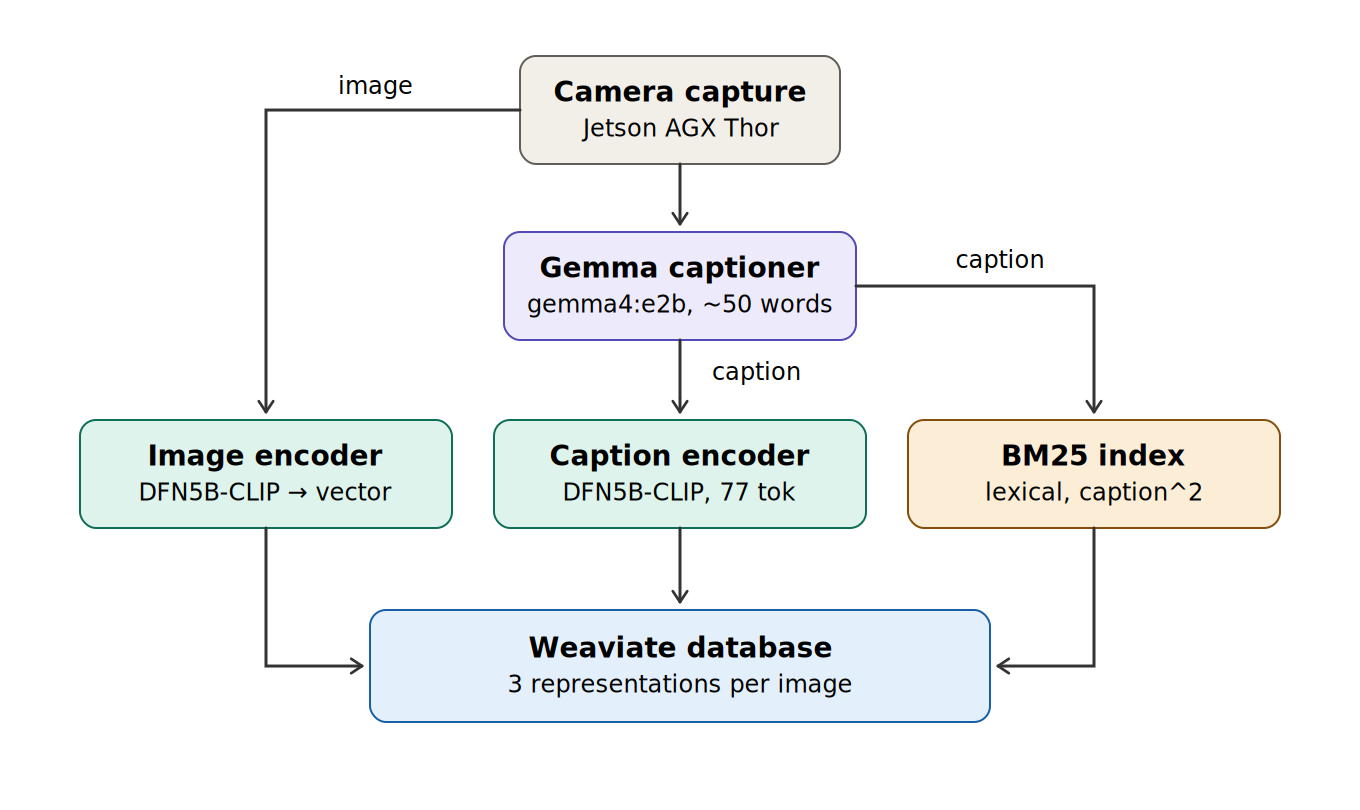
The raw image feeds two branches in parallel: a CLIP image encoder (the image vector) and a local vision-language captioner. The generated caption then feeds its own two branches: a CLIP text encoder (the caption vector) and a BM25 lexical index. All three representations land in the vector database, keyed to the same image.
Search — querying and fusion
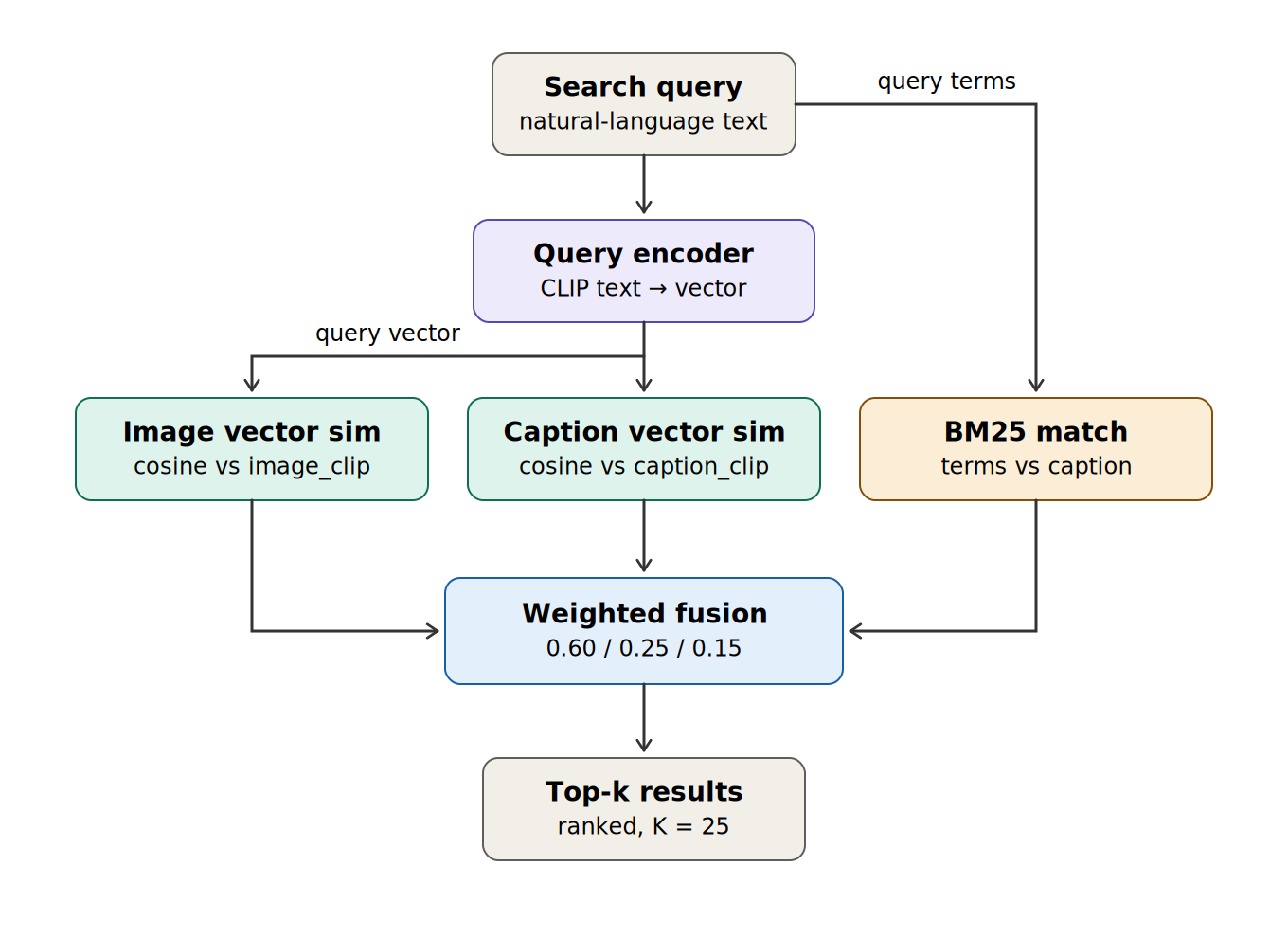
The query splits the same way the image did. The encoded query vector drives cosine similarity against both the image vector and the caption vector, while the raw query terms drive the BM25 lexical leg. Each leg is normalized independently, then combined with fixed fusion weights. The top results come straight out of the fused score.
A newer configuration: long captions
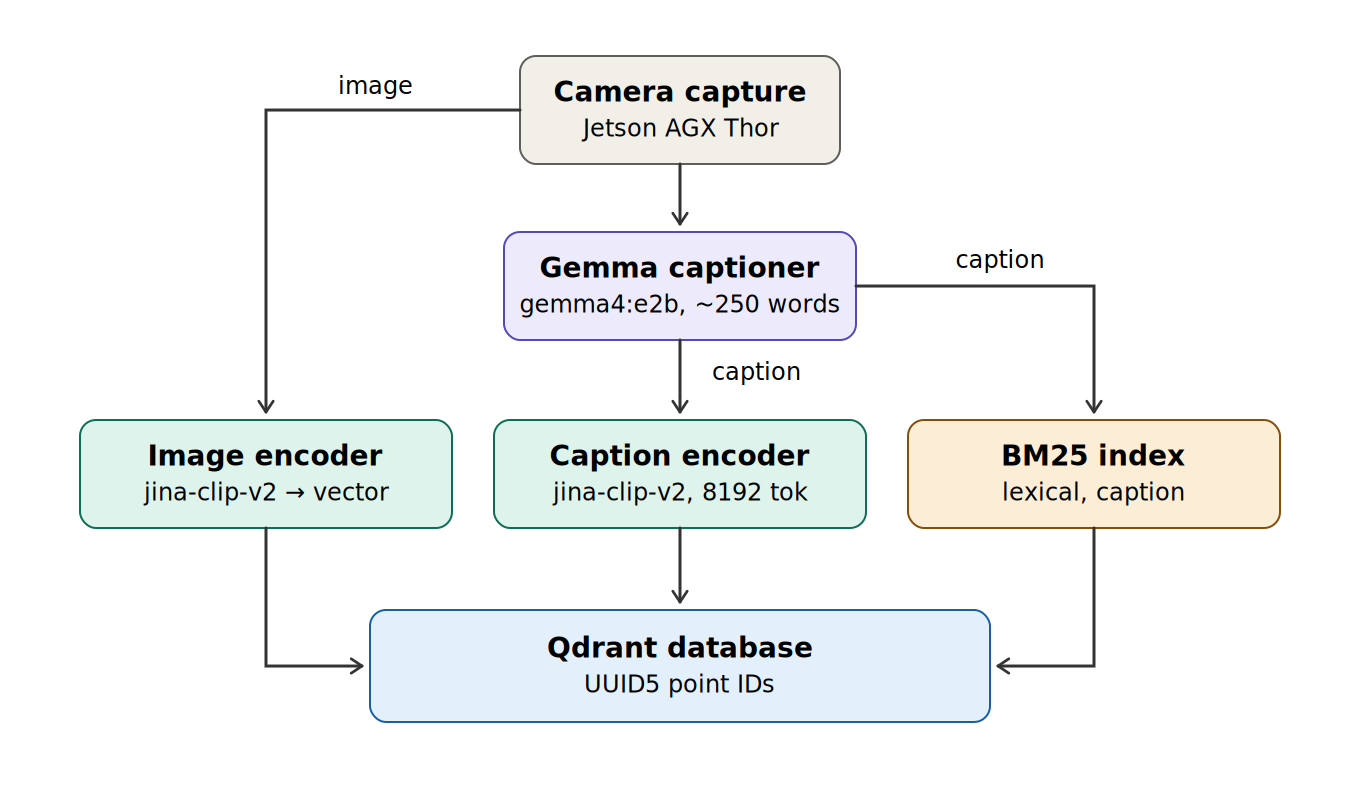
A later configuration keeps the same three-leg shape but lifts a key constraint. The earlier CLIP text encoder capped captions at 77 tokens, which forced a hard tradeoff: detailed captions were too long to embed (reachable only through keyword matching), so captions had to be shrunk to fit — embeddable, but thin. Switching to a long-context embedder (jina-clip-v2, 8192 tokens) removes that ceiling, so the caption can grow to ~250 words and be embedded. Captioner "thinking" is turned off since it consumed the token budget for no measurable gain, and storage moves to Qdrant.
Configurations at a glance
| Baseline | Dual-embedding | Long-caption | |
|---|---|---|---|
| Caption model | gemma-3-4b-it | gemma4:e2b, thinking on | gemma4:e2b, thinking off |
| Caption length | ~150 words | ~50 words | ~250 words |
| Embedder | DFN5B-CLIP (77 tok) | DFN5B-CLIP (77 tok) | jina-clip-v2 (8192 tok) |
| Vectors stored | image only | image + caption | image + caption |
| Fusion | 75% image + 25% BM25 | 60% image + 25% caption + 15% BM25 | image + caption + BM25 |
| Database | Weaviate | Weaviate | Qdrant |
Color key for the diagrams: gray = source/output, purple = neural model, teal = CLIP vector operations, amber = BM25 lexical, blue = storage/fusion.
How it performs
Across five public image-search benchmarks, the edge system is compared against a set of datacenter reference systems on a single composite score. Edge configurations are shown in teal.
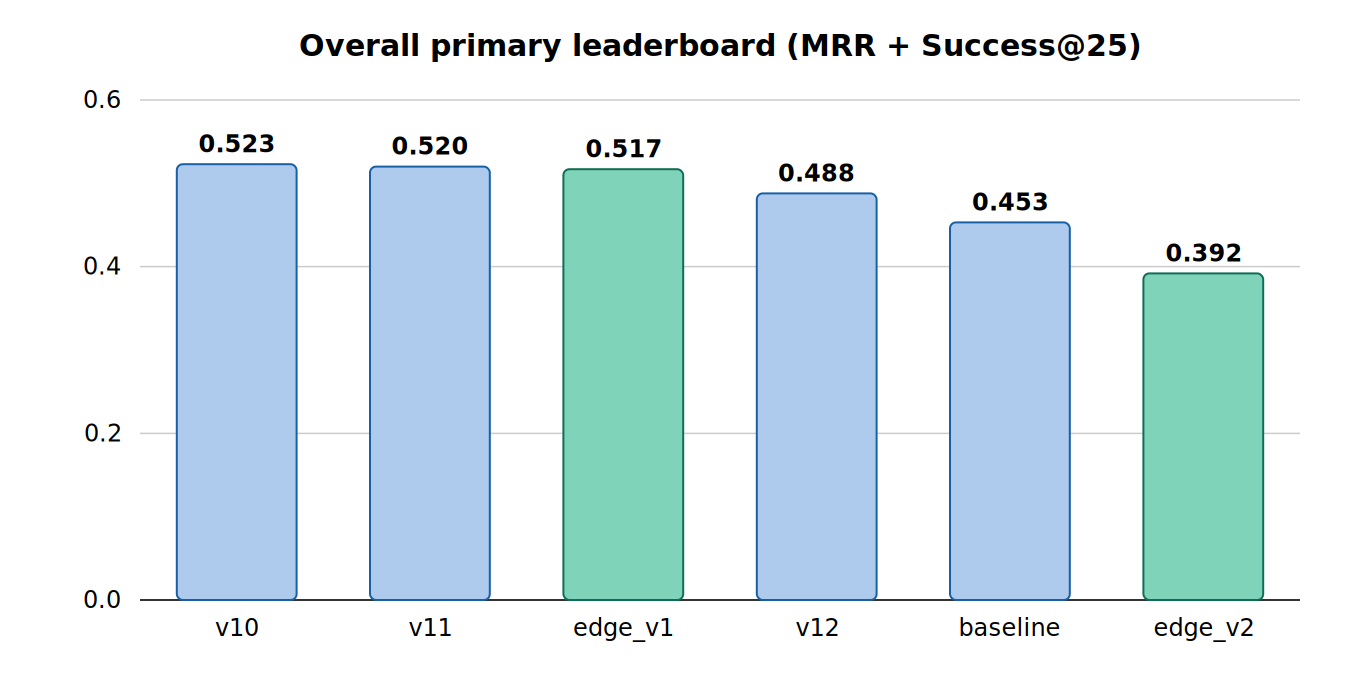
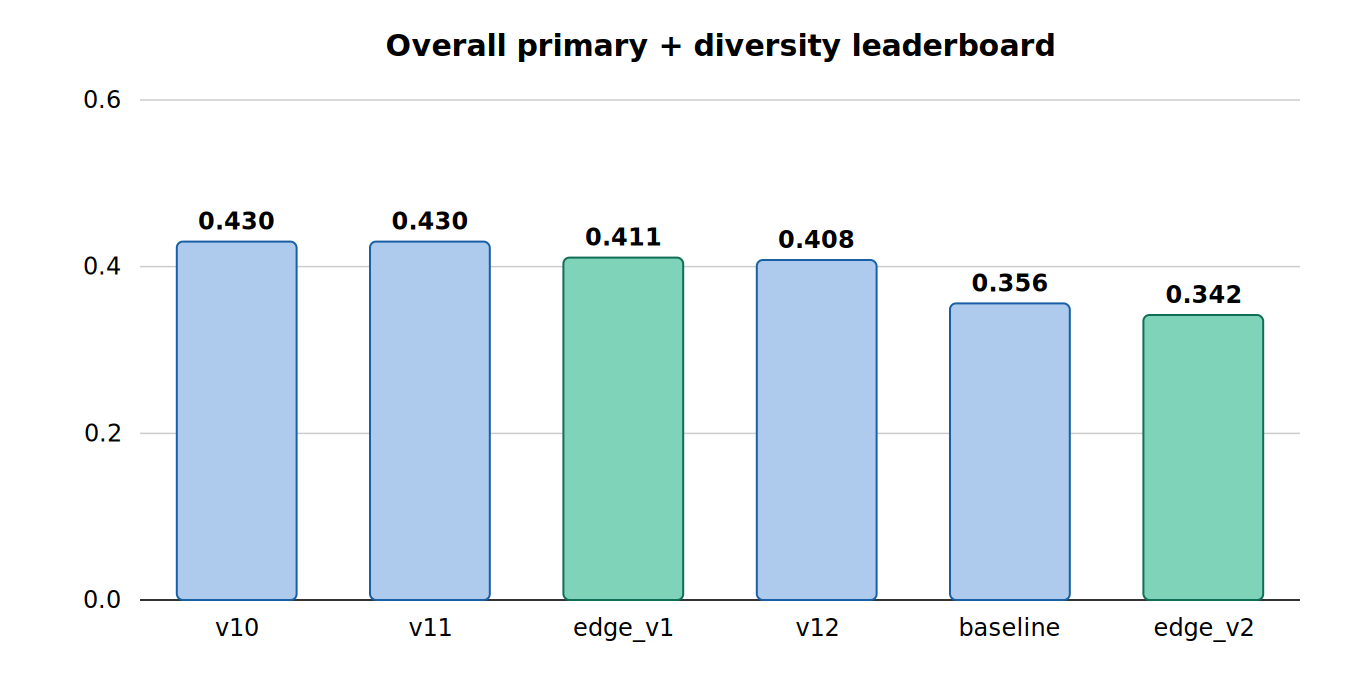
Despite running fully on-device, the edge baseline ranks 3rd of 6 on the primary composite (0.517, within ~0.006 of the top reference systems) and posts the highest Success@25 of any system (0.697) — it most reliably surfaces a relevant image in the top results. Its lower MRR, from having no reranker, is what keeps it just behind the two leaders.
Source code and configuration are available in the project repository.